
The Five-Year Gap in VA’s Atsugi Exposure Timeline
VFEA’s review of historical records indicates that the Incinerator Complex adjacent to NAF Atsugi was operating by March 1980—yet VA currently identifies 1985 as the beginning of the exposure period.
For over 17 years, the U.S. Department of Veterans Affairs (VA) has characterized exposure to pollutants from the Shinkampo Incinerator Complex (SIC), located adjacent to Naval Air Facility (NAF) Atsugi, Japan, as occurring between 1985 and 2001.
The historical record indicates that VA’s timeline begins five years too late.
A comprehensive review conducted by Veteran Families for Education and Awareness (VFEA) establishes that the SIC began operating in 1980, five years before the 1985 date currently used by VA. The evidence includes Department of the Navy (DON/Navy), U.S. Congressional, and Japanese government records; and an affidavit from the facility's operator, Tetsuro Murata, obtained in connection with the U.S. Department of Justice’s (DOJ) 2000 lawsuit against the burninig facility.
This is not simply a discrepancy in historical dates. The distinction directly affects veterans who served at NAF Atsugi between 1980 and 1985, influencing how their exposure-related disability claims are evaluated and how future research into their potential exposures is conducted.
The Problem With the 1985 Start Date
VA currently identifies 1985 to 2001 as the exposure period for the SIC. This date range appears in VA internal and external exposure summaries, as well as the M21-1 Adjudication Procedures Manual.
The VA’s earliest identified use of 1985 as the SIC exposure start date appears in written testimony submitted by the VA for the October 8, 2009, hearing of the U.S. Senate Committee on Veterans’ Affairs, “VA/DOD Response to Certain Military Exposures.” In his prepared written statement, Michael R. Peterson, Chief Consultant for the VHA Environmental Health Strategic Healthcare Group, Office of Public Health & Environmental Hazards, stated that the SIC “began operations” in 1985.
However, during that same hearing, Paul Gillooly, Ph.D., Captain, Medical Service Corps, U.S. Navy (Retired), Navy/Marine Corps Public Health Center, informed Congress that the incinerators were “installed first in the early 1980s.” He further explained that they “burned municipal waste” and that “Navy health concerns first arose around 1985 when the incinerator applied for and was granted a license to burn industrial waste.”
The statements appear to describe materially different timelines for the beginning of SIC operations. Gillooly’s testimony is particularly significant because it indicates that the incinerators were already operating and burning waste before 1985.
The inconsistency prompted VFEA to conduct a closer review of the underlying historical record and assess whether VA’s 1985–2001 exposure period accurately reflects the operational history of the incinerator complex.
Reviewing the Records
During its in-depth review of VA, DON, U.S. congressional, and Japanese government records, VFEA identified numerous sources addressing the operational history of the Shinkampo Incinerator Complex.
While the end of the airborne-exposure period is comparatively consistent—2001, or more specifically, April 30, 2001, the date the incinerator was shut down—the documented start date varies across historical records.
Certain DON materials—including the final 2002 health risk assessment, the 2009 cohort health study, and Navy Medicine’s Atsugi webpage—identify 1985 as the year operations began. Other DON records and testimony, however, identify 1980 as the beginning of operations, while Japanese government records likewise place the beginning of operations in 1980.
The October 8, 2009 congressional hearing also references 1983 from a non-government source, in addition to the “early 1980s” and 1985.
Taken together, the records demonstrate that the 1985 start date is not uniformly supported by the historical record. This inconsistency warranted a closer examination of the underlying evidence to determine when the SIC actually began operating and, consequently, when airborne emissions associated with its operations may have begun.
The Historical Record Establishes a 1980 Start Date
After a comprehensive review, VFEA finds the historical evidence sufficient to establish that the incinerator complex adjacent to NAF Atsugi began operating in 1980.
In an affidavit filed in connection with the DOJ’s 2000 lawsuit against the facility, operator Tetsuro Murata stated that the complex was commissioned in 1978 and “began operation in 1980.” Murata also described significant deficiencies in the facility’s design and early operation. According to his account, the facilities were developed by a contractor with no prior expertise in incineration-system design, requiring staff to “approach complete incineration using trial and error during actual operations over and over again.”
The 1980 timeframe is independently corroborated by multiple U.S. Navy records. Page 37 of the Navy Environmental Health Center’s 1995 Preliminary Human Health Risk Evaluation for NAF Atsugi states that “the incineration plant has operated since 1980.” The Navy’s Summer 2001 issue of Currents, likewise described Shinkampo—renamed Envirotech in 1999—as a waste-disposal firm whose incinerators had emitted “dioxin-heavy clouds” from the complex “since 1980.”
Japanese government records provide further corroboration. A July 9, 2002, meeting of the Japanese Diet’s House of Representatives Security Committee discusses the facility’s operations as beginning in 1980 and further pinpoints the start date to March 3, 1980.
Notably, none of the Japanese government records or the operator’s testimony reviewed by VFEA identifies 1985 as the beginning of operations.
The 1980 evidence is also consistent with Gillooly’s 2009 congressional testimony that the incinerators were “installed first in the early 1980s” and were already being used to burn municipal waste before 1985. Gillooly testified that Navy health concerns arose around 1985, when the facility applied for and was granted a license to burn industrial waste. VFEA’s review identified evidence supporting that licensure change: in April 1985, the Kanagawa Prefectural Government issued the incinerator complex an intermediate ordinary industrial-waste disposal license.
The historical record therefore establishes a critical distinction: 1985 marked the facility’s authorization to conduct licensed industrial-waste disposal—not the beginning of its operations or burning activities. The identification of 1985 as the operational start date in certain DON records and VA exposure summaries appears to conflate the facility’s industrial-waste licensing date with the much earlier commencement of operations. The evidence instead places the beginning of operations in 1980, approximately five years before the exposure period currently recognized by VA.
Open Burning and Illicit Operations
A large Unrestricted Open Burn Pit at the Incinerator Complex Adjacent to NAF Atsugi
The issue is not simply that the complex existed before 1985. The historical record documents open burning, unauthorized disposal of industrial waste, and significant operational deficiencies during the facility’s early years.
The operator, Tetsuro Murata, managed or effectively controlled operations at the complex adjacent to NAF Atsugi from the outset. Japanese government records document a substantial history of legal and regulatory violations associated with Murata. In a September 29, 1998, meeting of the Japanese Diet’s House of Councilors Committee on National Land and Environment, Japanese officials reported that Murata had been arrested at least ten times and indicted four times for conduct including illegal dumping, open burning, and bribery, and discussed the company’s repeated exceedance of permitted waste volumes. A June 6, 2001, meeting of the Japanese Diet’s House of Representatives Committee on Budget and Administrative Oversight likewise described the company as a habitual violator and discussed additional misconduct, including repeated operation outside permitted hours, destruction of irrigation canals, tax evasion, and disguised payments to organized-crime figures.
Several documented violations occurred during the 1980–1985 period. The Asahi Shimbun, reporting on October 5, 1984, stated that Murata had bribed a municipal official in November 1980 to turn a blind eye to the open burning of industrial waste. Then, in May 1984, Kanagawa Prefectural Police arrested Murata and two other executives associated with the Shinkampo Incinerator Complex after discovering waste being burned in a large open-air pit. The reported charges included illegal open-pit burning and unauthorized disposal of industrial waste in violation of the Kanagawa Prefecture Pollution Prevention Ordinance and the Waste Disposal and Public Cleansing Law. (Pacific Stars and Stripes, February 11, 1999, “Dioxins contaminate air around Atsugi Base.”)
The accounts of open burning are consistent with, and further corroborated by, the Navy’s own descriptions of the facility’s early operations. Navy Medicine’s 1995 Preliminary Human Health Risk Evaluation for NAF Atsugi states that “the incineration plant has operated since 1980” and explains that the facility evolved from an “unrestricted open burn pit” into the incinerator system in place at the time of the assessment (1995). On April 17, 1997, Bryan Murphy, NAF Atsugi’s Environmental Protection Specialist, likewise described the facility’s earlier configuration, stating that “Jinkanpo (Shinkampo) transformed itself from four smallish incinerators, little more than furnaces with short stacks attached, plus an open pit burn area, to its present configuration of three larger incinerators equipped with anti-pollution controls, which it rarely used until recently.” Finally, in a written response to post-hearing questions arising from the 2009 Senate hearing discussed above, Navy Medicine’s Dr. Gillooly stated that “the operation began as a small burn pit” and “grew to a full scale incinerator over the years.” Taken together, these Navy sources independently corroborate the contemporaneous accounts of open-pit burning during the facility’s early operation.
The significance of this documented history is further underscored by the operator’s own account of the facility’s early operational deficiencies. In his affidavit, Murata acknowledged that the incineration facilities had been developed by a contractor with no prior expertise in incineration-system design and that, once operations began, personnel were forced to “approach complete incineration using trial and error during actual operations over and over again.”
The totality of these circumstances—including limited or absent use of pollution controls, repeated start-up and shutdown of the incinerators, incomplete combustion of waste, and the use of open burning—provides important context for evaluating the nature and potential magnitude of airborne hazards from the facility during its early years.
The Early Years Involved Significant Exposure-Relevant Conditions
These historical facts are significant because they show why the 1980–1985 period cannot reasonably be treated as an exposure-free period.
In April 1985, the Kanagawa Prefectural Government issued the facility an industrial-waste disposal license, formally authorizing activities that the historical record indicates had already been occurring for years. Gillooly, testifying on behalf of Navy Medicine, stated that the Navy’s health concerns first arose around 1985, but that statement does not establish that potentially hazardous operating conditions began that year.
The context of Gillooly’s statement must also be considered in light of the scientific and regulatory knowledge available in 1985. The understanding of the health risks associated with waste combustion and its emissions continued to evolve substantially in the decades that followed. In particular, the significance of contaminants such as dioxins, particulate matter, and other combustion byproducts became better characterized, while increasingly stringent emission standards were adopted in response to growing knowledge of their potential health and environmental effects. Accordingly, what Navy officials recognized or considered concerning at the time does not necessarily reflect what is understood today about the potential hazards associated with the facility’s operations and emissions.
The evidence reviewed by VFEA identifies several concerning conditions during the facility’s early operating period that are directly relevant to the potential for airborne exposure:
Unrestricted open-air burning
Inadequate incinerator design and anti-pollution control systems
Difficulty achieving complete incineration
Unauthorized burning and disposal of industrial waste
Operation in close proximity to on-base family housing, work areas, recreational areas, an elementary school, and childcare facilities
A June 27, 2007, Japan Times article, “Is This a Poison Cover-Up?”, provides a firsthand account from Andrea, a former NAF Atsugi resident who lived on base from 1982 to 1985. She described encountering a foul odor and a “dark heavy haze” over the base on a daily basis, at times making it difficult to breathe. She also reported experiencing severe migraines, rectal bleeding, and gastrointestinal cramping during her time at Atsugi. Years later, she reported being diagnosed with Crohn’s disease, an inflammatory bowel disease, as well as primary sclerosing cholangitis (PSC), a chronic disease affecting the bile ducts.
Andrea’s account does not, by itself, establish that her medical conditions were caused by exposure to the SIC. It does, however, provide a firsthand account of the environmental conditions experienced by a NAF Atsugi resident during the 1982–1985 period—years that fall outside VA’s currently recognized exposure window.
The significance of the historical record is not that it establishes a particular level of exposure or proves that any individual illness was caused by the SIC. Rather, it establishes that the facility was operating during 1980–1985 under conditions directly relevant to the potential for airborne exposure. The absence of an industrial-waste license or Navy “concern” before April 1985 does not negate those documented operating conditions or the potential hazards associated with them. The first five years of the incinerator complex’s operations should therefore be recognized as part of the relevant exposure history.
Why the Five-Year Difference Matters for Veterans
The discrepancy has direct consequences for veterans who served at NAF Atsugi before 1985.
VA's M21-1 Adjudication Procedures Manual currently directs adjudicators to “concede exposure” to pollutants from the waste incinerator near NAF Atsugi when the evidence verifies a veteran's service at NAF Atsugi between 1985 and 2001.
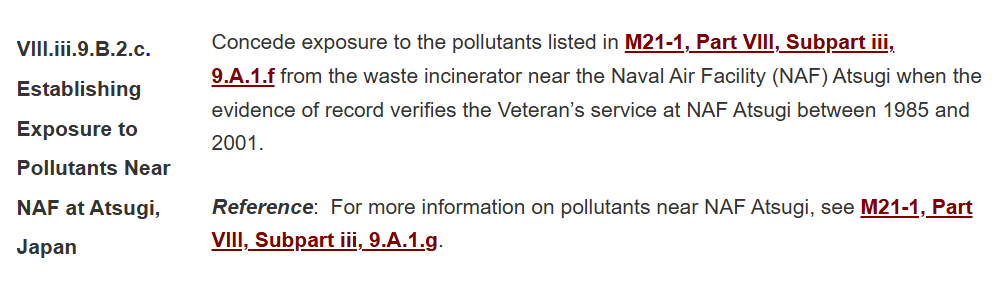
This creates a five-year gap for veterans who served at NAF Atsugi between 1980 and 1985. If the SIC was already operating during this period—as the historical evidence indicates—these veterans were present at the same installation while the same incinerator complex was operating, yet their service falls outside the period for which VA's M21-1 directs adjudicators to concede exposure.
The distinction is particularly important under VA's Toxic Exposure Risk Activity (TERA) framework. Once TERA participation is established, 38 U.S.C. § 1168 generally requires VA to obtain a medical examination and medical opinion addressing whether a claimed disability is at least as likely as not related to the veteran's participation in the TERA, subject to the statutory exception.
Thus, the 1985 cutoff is not merely a historical discrepancy. It can affect whether VA concedes the underlying SIC exposure in the first place and, consequently, whether the veteran’s service is recognized as involving participation in a TERA for purposes of claims development.
A veteran who served at NAF Atsugi in 1982 and a veteran who served there in 1987 could have been stationed at the same installation while the same incinerator complex was operating. Yet under VA's current M21-1 guidance, the 1987 veteran's service falls within the period for which exposure may be conceded, while the 1982 veteran's service does not.
For veterans like Andrea, who lived at NAF Atsugi during the 1982–1985 period, the issue therefore extends beyond historical accuracy. The date VA uses to define the SIC exposure period can determine whether documented service at NAF Atsugi is sufficient for VA to concede SIC exposure and, in turn, whether the veteran’s claim receives the exposure-related development that VA provides when participation in a TERA is established.
Takeaways
The evidence reviewed by VFEA indicates that VA’s use of 1985 as the beginning of the SIC exposure period is inconsistent with the broader historical record. Multiple sources—including the facility operator’s sworn account, Navy documentation, congressional testimony, and Japanese government records—place the beginning of operations in 1980, with Japanese records further identifying March 3, 1980. The evidence indicates that 1985 corresponds to the facility’s authorization to conduct licensed industrial-waste disposal and to the period when “Navy health concerns first arose,” rather than to the beginning of the incinerator complex’s operations or the potential for airborne exposures. By 1985, the facility had already been operating for approximately five years, during which open burning and unauthorized industrial-waste disposal were occurring.
The VA and DON should therefore review and update their references to the NAF Atsugi SIC exposure period, including the M21-1 Adjudication Procedures Manual, to reflect the historical evidence supporting an operating period beginning March 3, 1980, and ending April 30, 2001.
Correcting the exposure period would improve the accuracy of the historical record, provide a more complete foundation for research into the Atsugi cohort, and ensure that veterans who served at NAF Atsugi before 1985 are not excluded from exposure consideration based on a factual error. For those veterans, the five-year discrepancy is not merely a historical issue; it may affect whether VA concedes SIC exposure and how exposure-related claims are subsequently developed and evaluated.