
The VA Lists Seven Chemicals of Concern. The Navy Found More Than Forty.
For years, the Department of Veterans Affairs (VA) has recognized seven chemicals of concern associated with exposures from the Shinkampo Incinerator Complex at Naval Air Facility (NAF) Atsugi.
According to the VA's M21-1 Adjudication Manual and other VA exposure summaries:
"Identified chemicals included: chloroform, 1,2-dichloroethane (1,2-DCE), methylene chloride, trichloroethylene (TCE), chromium, dioxins and furans, and particulate matter."
At first glance, this appears to be a complete list of hazardous contaminants associated with the Shinkampo Incinerator Complex.
However, the Navy's own environmental investigations document a much broader range of contaminants.
This omission is noteworthy as the VA's adjudication manual and exposure summaries do not identify this as an abbreviated summary, nor do they clearly direct readers to a more comprehensive contaminant list elsewhere in VA guidance or records.
What the Navy Found
Between 1988 and 2001, the Navy conducted multiple environmental sampling campaigns and three health risk assessments to evaluate emissions from the Shinkampo Incinerator Complex.
The Navy's final 2002 Health Risk Assessment identified approximately 269 chemical analytes and labeled more than 40 as contaminants of concern in the ambient air due to maximum concentrations exceededing EPA screening levels used at the time.
Earlier investigations also documented contaminants of concern:
The discrepancy raises an important question:
Why does the VA’s exposure summaries and adjudication guidance only reference seven chemicals when the Navy's own investigations documented many more?
Why the Difference Matters
Chemicals identified in VA exposure summaries and adjudication guidance directly shape how disability claims are developed and evaluated. A veteran may reasonably attribute a medical condition to a contaminant documented in the Navy's environmental investigations, unaware that the contaminant is absent from VA's guidance entirely. This concern is compounded by the fact that the Individual Longitudinal Exposure Record (ILER), the centralized system VA most commonly relies on to evaluate toxic exposure claims, primarily reflects exposures occuring after September 11, 2001. As a result, many pre-9/11 exposures—including the Atsugi incinerator exposure—are not captured in the system at all, making VA’s written exposure summaries and adjudication guidance even more critical for adjudicators and clinicians seeking to understand a veteran’s exposure history.
This limitation is particularly significant given how narrowly M21-1, Part VIII, Subpart iii, 9.B.2.c, “Establishing Exposure to Pollutants Near NAF at Atsugi, Japan” is written. This provision from the VA’s adjudication procedures manual instructs adjudicators to “concede exposure to the pollutants listed in M21-1, Part VIII, Subpart iii, 9.A.1.f from the waste incinerator near the NAF Atsugi when the evidence of record verifies the Veteran’s service at NAF Atsugi between 1985 and 2001.”
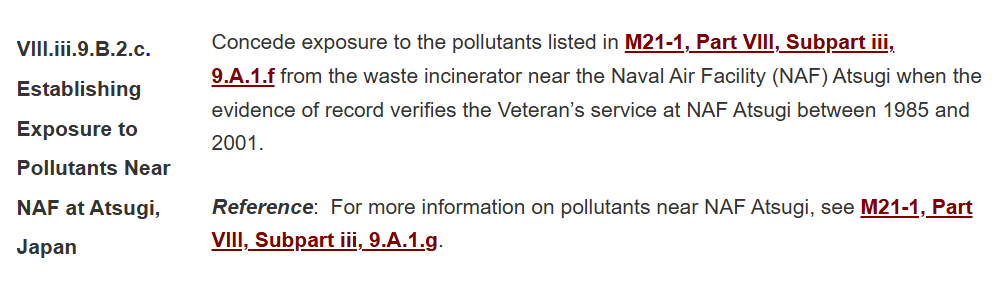
Note: The reference to section 9.A.1.f is incorrect. That section addresses “National Guard Exposure to Chromium VI at Qarmat Ali Water Treatment Plant in Basrah, Iraq." The correct citation is Section 9.A.1.g, “Details on Exposure to Pollutants From a Waste Incinerator Near NAF in Atsugi, Japan.”
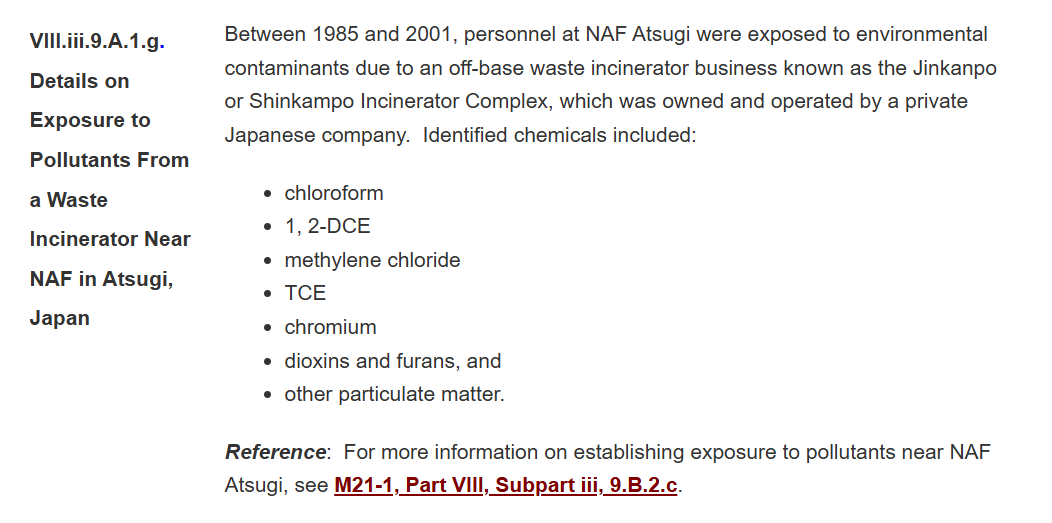
The correct section, 9.A.1.g, details a list of only seven pollutants related to the incinerator exposure. In practice, this creates a meaningful risk of under-adjudication. If an adjudicator relies primarily on VA's guidance without independently reviewing the Navy's underlying environmental reports, they may conclude that a veteran was not exposed to a claimed contaminant simply because it does not appear on VA's list. That determination can have significant consequences: it may affect whether the exposure is conceded, whether the claim qualifies as a Toxic Exposure Risk Activity (TERA), and ultimately whether the veteran is afforded a VA medical examination and nexus opinion under the TERA framework.
The implications extend beyond claims adjudication to medical evaluation. A VA examiner or healthcare provider who relies primarily on VA's exposure summaries, TERA Memorandums, and ILER entries may have no practical way of knowing that a veteran was potentially exposed to additional contaminants documented in the Navy's environmental investigations. Because differential diagnoses, clinical evaluations, and nexus opinions depend on an accurate exposure history, an incomplete record can influence each of these determinations from the outset.
This discrepancy would be less consequential if VA's list were clearly framed as an abbreviated summary or explicitly directed adjudicators and examiners to the Navy's list of contaminants. It does neither. Instead, as currently written, the guidance presents a limited list of contaminants without clearly indicating that additional contaminants were documented in the Navy's environmental investigations. For adjudicators and clinicians relying on VA's guidance as a primary source of exposure information, this can create the impression that the listed chemicals represent the full scope of documented contaminants associated with the Atsugi incinerator.
For veterans who served at NAF Atsugi, correcting this is not merely a technical matter—it goes to the heart of accurate claims processing and informed medical evaluation. Ensuring that VA's guidance reflects the Navy's documented findings would help ensure that Toxic Exposure Risk Activities are properly recognized, medical evaluations are based on the most complete exposure history available, and disability claims are developed and decided using the best available scientific evidence.
The Navy's 2002 Chemical List Was Accurate—But Not Comprehensive
While the Navy's final 2002 Health Risk Assessment identifies a more thorough list of chemicals, it does have a couple of limitations.
First, its quantitative risk analysis relied primarily on environmental sampling conducted from 1998 to 1999, rather than the full body of sampling collected throughout the facility's operational history.
While this is not unsual for a health risk assessment, this matters because the Shinkampo Incinerator did not operate under consistent conditions throughout its history. Over two decades, it evolved from an uncontrolled open burn pit and poorly controlled incinerator into a facility with progressively improved pollution controls before closing in 2001.
The open burn pit closed in 1984.
Existing incinerators were upgraded with wet-quench scrubbers (a pollution control) in 1987, 1991, and 1993.
Extended quench sections and baghouse filters were added to all three units in 2000.
Operational practices also changed with increasing scrutiny. Navy field reports from the mid-to-late 1990s documented repeated instances in which the operator interferred with sampling efforts. The complex reduced throughput, temporarily shut down equipment, or burned cleaner waste streams during environmental monitoring, with emissions reportedly increasing again after visible sampling equipment was removed.
Because emissions varied with the waste being burned, operating conditions, and pollution controls in place, no single sampling campaign can fully characterize the range of exposures experienced over the facility's lifetime. Sampling conducted during 1998–1999 may therefore not fully reflect conditions during earlier years, particularly before heighted scrutiny of operational practices and the installation and use of pollution control equipment. During the earlier period, emissions for some contaminants may have been up to an order of magnitude (approximately 10-fold) higher than those measured after pollution-control upgrades.
Additionally, the Health Risk Assessment itself is well over two decades old. It largely relied on the toxicological data, exposure assumptions, analytical methods, and EPA guidance from the 1980s and 90s. Since 2002, environmental health science has advanced substantially, with new and updated toxicity values, screening criteria, and a better understanding of long-term and cumulative chemical exposures.
VFEA’s Updated Analysis
Although VFEA cannot formally update the Navy's Health Risk Assessment, we can evaluate the Navy's historical environmental data using current EPA screening levels and health-protective criteria. To provide the most comprehensive review possible, VFEA reviewed all publicly available Navy environmental investigations rather than relying solely on the 1998–1999 sampling campaign used in the Navy's final risk assessment.
For each contaminant identified in the historical sampling records, VFEA compared the highest documented concentration reported across all available studies with current EPA Regional Screening Levels (RSLs) and National Ambient Air Quality Standards (NAAQS). Using the maximum measured concentration provides a conservative, worst-case screening approach that captures a more representative range of contamination documented during the facility's operation.
This analysis is not intended to estimate an individual's exposure, predict disease risk, or replace a formal human health risk assessment. Rather, it serves as a screening-level evaluation designed to identify contaminants that reached concentrations warranting further consideration under today's environmental health standards.
By applying modern EPA toxicity values and screening criteria to the Navy's historical measurements, VFEA provides an updated assessment of documented chemical contamination at NAF Atsugi that reflects both the full body of available environmental sampling data and the significant advances in environmental health science since 2002. The resulting contaminant lists are intended as a research and educational resource for veterans, families, clinicians, researchers, and policymakers.
VFEA Findings
VFEA’s analysis found nearly 290 chemical analytes for air and soil between all avilable samplings. Based on current EPA screening guidelines and regulations, approximately 83 were identified as contaminants of concern.
Ambient Air
70 contaminants of concern were identified in the ambient air
38 chemicals exceed EPA residential air Regional Screening Levels (RSLs) for cancer
53 chemicals exceed EPA residential RSLs for non-cancer effects
6 chemicals exceed EPA National Ambient AIr Quality Standards for criteria pollutants
Soil
21 contaminants of concern were identified in the soil
8 chemicals exceed EPA residential soil RSLs for cancer
16 chemicals exceed EPA residential soil RSLs for non-cancer effects
Takeaways
At a minimum, the Department of Veterans Affairs should update its M21-1 Adjudication Manual and related exposure summaries to reflect the contaminants identified in the Navy's final 2002 Health Risk Assessment, rather than continuing to reference only seven chemicals.
Ideally, the Department of the Navy should conduct an updated Health Risk Assessment for the Shinkampo Incinerator Complex using current toxicological data and modern risk assessment methodologies. The Department of Veterans Affairs should then integrate the updated findings into its exposure guidance, adjudication policies, and clinical systems to ensure veterans' claims and healthcare decisions are informed by the best available scientific evidence.
The existing assessment is now more than two decades old and reflects the scientific knowledge, exposure assumptions, toxicological data, and regulatory guidance available at the time. Since then, environmental health science has advanced considerably. A modern reassessment would provide a more accurate characterization of historical exposures, better inform healthcare and disability benefit decisions, guide future research, and improve the evidence base used by veterans, clinicians, researchers, and policymakers.
The veterans and families who lived and worked at NAF Atsugi deserve an updated exposure assessment—and a VA exposure record—that reflects both the full scope of the Navy's historical environmental data and the current state of environmental health science.